280z
Air Leaks (Vacuum Leaks)
An engine fundamentally pulls air in, burns it, then pushes it out. These processes require significant control and metering of all air entering and leaving the engine.
To operate efficiently and cleanly, engines have evolved to become "sealed" except for where air is drawn in (intake) and where combustion gases are pushed out (exhaust). Since the fuel tank and fuel lines are connected to the engine, they are also sealed. Some other air enters the sealed system to replace the space occupied by fuel as it is burned. Some air enters the sealed system through a carbon barrier to facilitate the burning of gasoline vapour fumes. No other air should enter the system.
Air leaks cause problems for sealed engines. The leaked air typically "sneaks "past the fuel metering system (AFM) and the engine ends up running lean. Since your foot on the accelerator pedal is the gate keeper for all air entering the engine, any leaks down stream from the throttle body (which your foot controls) will make the engine run faster as if your foot was letting it in.
If an air leak exists but a mechanic fails to find
it, he may incorrectly adjust the engine to compensate by adding extra fuel and
lowering the idle speed.
If is
important to check engines for air leaks at least once. If they occur after
that, usually higher idle or different coloured plugs or poorer performance will
alert the driver.
Fortunately air leaks are easy to find and resolve.
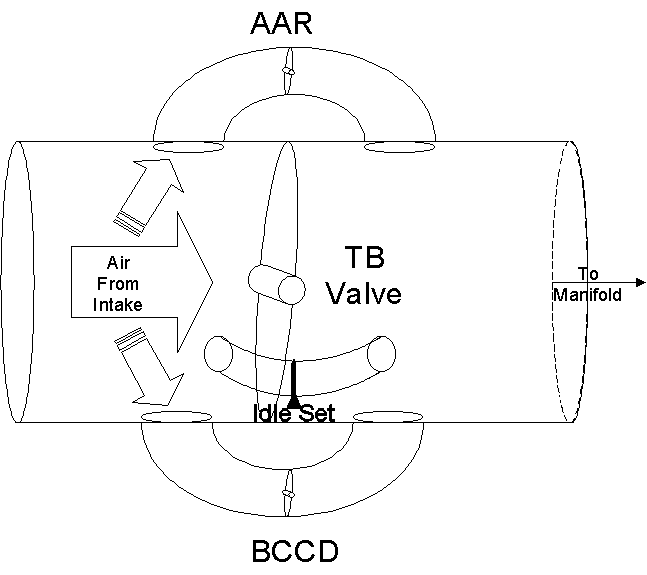
The 280z's L-Jetronic system has a conventional throttle valve but inside the throttle body, there are passages that bypass the valve. Air traveling in these special passages is metered and the EFI system will know about it and mix the correct amount of fuel. However if these valves are open when they should not be, the engine will run faster and have the symptom of an air leak into the sealed engine.
These Internal-to-the-sealed-engine leaks are 99% limited to the throttle body area though an AFM leak can occur. When this type of leak bypasses the throttle body (TB), a fast idle will result. Here are the primary TB leaks and their resolution:
1. Aux Air Regulator (AAR) stuck open
(mechanically). This valve's purpose is to cause a controlled leak when car is
cold. As the car warms up, the valve closes.
2. Boost Controlled Deceleration Device stuck open (electrically). This valve's
purpose is to allow more air into combustion chamber when you pull foot off gas
quickly.
3. Idle Set screw improperly set. This valve's purpose is to adjust air
bypassing the TB so that the idle speed can be set.
4. Throttle Body valve gummed up and not closing fully. Since this valve is
mechanical and controlled with a complex linkage from the gas pedal. A weak
return spring on the TB assembly or a binding link could be the culprit.
Unmetered Air Leaking into the sealed engine (Vacuum Leaks) causes the engine to run incorrectly and can occur in many parts of the engine.
External leaks in the intake manifold occur downstream from the AFM and are "unmetered". This extra air sneaks unnoticed past the AFM thus the ECU does not know about it. Since the ECU is unable to add the extra gas to mix with the extra air, the air/fuel mixture becomes lean. This can result in a faster idle and hotter engine. If the leak is big, the engine may stumble or stall out.
Common areas to check for manifold air leaks are:
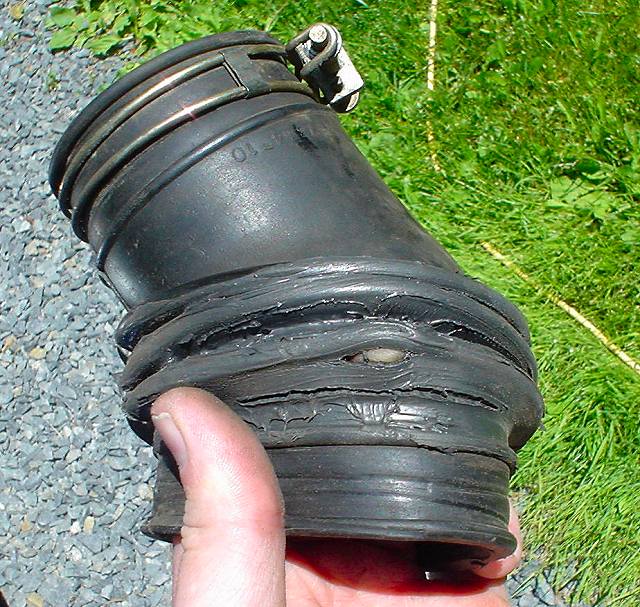
- Rubber boots between AFM and Throttle Body
Ripped AFM to TB boot (note the silicone applied by the previous owner)
- Vacuum hoses to manifold (brake booster, evaporative fuel canister, pollution devices, fuel pressure regulator, distributor)
- Hoses to/from AAR and valve cover breather
- manifold to head gasket
- injectors, cold start valve seals
External air leaks can also occur at the head or engine block. These typically cause the engine to stumble or even stall.
Common areas to check for engine air leaks are:
- Valve cover
- Oil cap
- Oil pan
- Dip stick seal
- front engine seal
Note: If the air to fuel mixture is set too rich at idle, a vacuum leak will be difficult to detect. Typically, a weak AFM spring will cause a richer mix and a typical check such as removing the oil cap to make the engine die will not do so.
Air Leaks can be located by doing the following:
1. Listening or feeling air being sucked into the engine where it should not enter. Typically a whistling sound can be heard when air leaks into the manifold at idle due to the strong vacuum. Putting your hand between the leak and your air can often block the sound. This interference technique is great for locating the leak when a noisy engine is idling. Sometimes you can feel the air entering the manifold or you can block it with a finger. A hose fitting with the hose pulled off is a common example. Just plug it with your finger and the engine idle speed will usually slow.
2. Spraying all areas with a starter fluid or similar solvent and listening for the idle speed to change.